 Loading... Please wait...
- +1 215-512-6258
- My Account

- Home
- Graver Slide Sharpening System
- Stone Setting Graver Slide Blocks
- Stone Setter Graver Slide Knife Block Set
Categories
Related Products
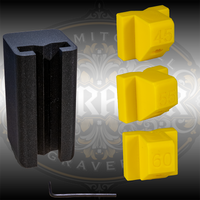

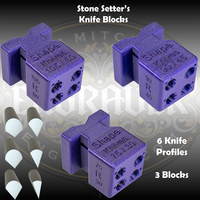


Stone Setter Graver Slide Knife Block Set
Hover over image to zoom


)
Product Description
Get the Set
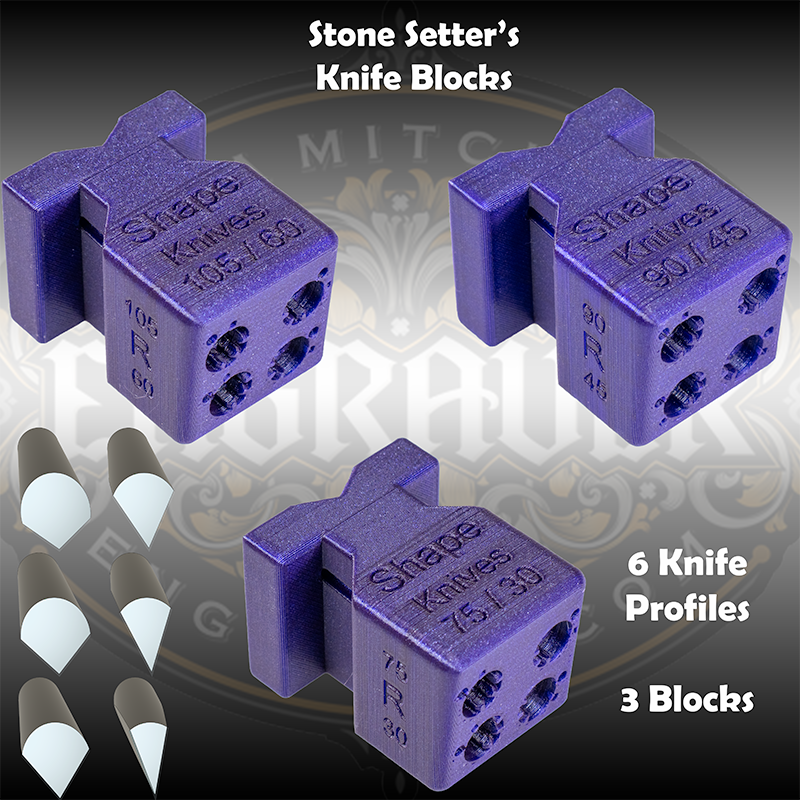
There are three Stone Setter’s Knife Blocks, each of which makes two different knife gravers. Knife gravers are V shaped gravers used to cut lines, curves, divides, and to clean up cuts or flash in tight places.
This set is intended for people who already own a Graver Slide Sharpening Tower, Universal Collets, and diamond wheels or other sharpening stones. If you don't have these items already, please consider the Stone Setter Graver Slide Knife Full Starter Set
Why Get This Set?
Commercially ground knives are evenly ground most of the way back to the shank of a graver. Self-ground gravers grind sides at a lift of anywhere from 1 to 5 degrees to make it faster and easier to grind by hand on a stone or hone.
When you want to engrave long smooth lines or curves, you typically add heels to a graver which helps keep the graver at an even depth and imparts a smooth finish during the cut.
When you are cutting irregular surfaces like a ring with complex curves, you can use gravers without heels for specific tasks. This is where the Stone Setter’s Knife Blocks come in handy. Stone Setter’s Knife Blocks quickly create simple V shapes at different angles that you can use instead of pre-ground commercial knife gravers. These blocks do not have heel geometries like our General Use or High Attack blocks have – instead each block can create two different knife gravers. If you typically just sharpen your commercial knife gravers by polishing the face of the graver, the Stone Setter’s Knife Blocks are for you.
Setter's Block Value
Each block is labeled with the two gravers it makes (105 / 60, 90 / 45 and 75 / 30). These blocks only create the sides of a graver – you will need a Face Fixer to add a face to your graver. Which face you choose will determine how easily the graver cuts and how strong the tip of the graver will be.
Picking The Face
A 60 degree face will give you the strongest tip and the bluntest cut. Commercial gravers typically come pre-ground with a 60 degree face. It is most useful in hard metals, especially if you are working at angles with tight curves. A well-sharpened 60 degree graver will usually go longer between sharpenings than gravers with shallower faces.
A 55 degree face has most of the tip strength of the 60 degree face but is easier to cut with. This is the face we use for our General Use gravers, and is Tira’s favorite face.
A 50 degree face further reduces tip strength in exchange for cutting ease.
A 45 degree face will give you the easiest cutting experience, but with the weakest tip. This is the traditional face for hand push engravers and is common among jewelers who work with soft precious metals. A lot of great work is done with 45 degree faces, but they tend to not perform as well in harder metals, deep cuts, or with narrow (60 degrees or less) gravers.
One more thing – when you add a face to a graver, you change the angle of the cutting edge slightly. A graver that starts as a 105 degree V angle without a face gets narrower as you grind shallower faces. This is true for commercial gravers, too. The change can be subtle, but it is real. For the engineer-types among you, the below table lists the actual cutting edge for each face by graver profile:
|
Knife Graver Face Angles |
||||
|
Profile |
60 |
55 |
50 |
45 |
|
105 |
100.4 |
98 |
95 |
91.3 |
|
90 |
85.7 |
83.3 |
80.4 |
79.6 |
|
75 |
71.5 |
69.4 |
66.7 |
63.6 |
|
60 |
57.7 |
55.9 |
53.8 |
51.3 |
|
45 |
44.2 |
43 |
41.4 |
39.6 |
|
30 |
31 |
30.4 |
29.5 |
28.5 |