 Loading... Please wait...
- +1 215-512-6258
- My Account

- Home
- Graver Slide Sharpening System
- Individual Blocks
- 90 45 Stone Setter Graver Slide Knife Block
- Home
- Graver Slide Sharpening System
- Stone Setting Graver Slide Blocks
- 90 45 Stone Setter Graver Slide Knife Block
Categories
Related Products
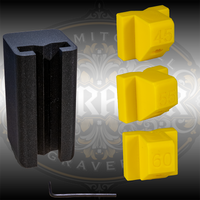

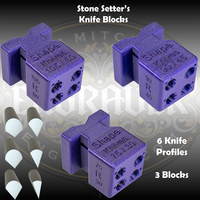


90 45 Stone Setter Graver Slide Knife Block

Hover over image to zoom


)
Product Description
1 Graver Block - 2 Specialized Gravers!
The 90 - 45 Graver Slide™ Knife Sharpening Block shapes two gravers - a 90 degree Knife Graver, and a 45 degree Knife Graver. These two V gravers are not intended to have heels and can be made with any face (separate Face Fixer Block required). These blocks were created specifically with stone setters in mind - you can quickly grind & sharpen V gravers from any type of blank and use them the same way you use commercially made Knife or V gravers for a fraction of the price of a commercial graver.
Commercially ground knives are evenly ground most of the way back to the shank of a graver. Self-ground gravers grind sides at a lift of anywhere from 1 to 5 degrees to make it faster and easier to grind by hand on a stone or hone. The geometry behind this block uses a higher than normal lift of 5 degrees to reduce the amount of grinding time to achieve the shape of a graver.
Stone setters typically use these gravers to cut irregular surfaces like a ring with complex curves, you can use gravers without heels for specific tasks. This block does not have heel geometries like our General Use or High Attack blocks have. If you typically just sharpen your commercial knife gravers by polishing the face of the graver, the Stone Setter’s Knife Blocks are for you.
Choosing Your Face
This block only creates the sides of a graver – you will need a Face Fixer to add a face to your graver. Which face you choose will determine how easily the graver cuts and how strong the tip of the graver will be.
A 60 degree face will give you the strongest tip and the bluntest cut. Commercial gravers typically come pre-ground with a 60 degree face. It is most useful in hard metals, especially if you are working at angles with tight curves. A well-sharpened 60 degree graver will usually go longer between sharpenings than gravers with shallower faces.
A 55 degree face has most of the tip strength of the 60 degree face but is easier to cut with. This is the face we use for our General Use gravers, and is Tira’s favorite face.
A 50 degree face further reduces tip strength in exchange for cutting ease.
A 45 degree face will give you the easiest cutting experience, but with the weakest tip. This is the traditional face for hand push engravers and is common among jewelers who work with soft precious metals. A lot of great work is done with 45 degree faces, but they tend to not perform as well in harder metals, deep cuts, or with narrow (60 degrees or less) gravers.
One more thing – when you add a face to a graver, you change the angle of the cutting edge slightly. A graver that starts as a 105 degree V angle without a face gets narrower as you grind shallower faces. This is true for commercial gravers, too. The change can be subtle, but it is real. For the engineer-types among you, the below table lists the actual cutting edge for each face by graver profile:
|
Knife Graver Face Angles |
||||
|
Profile |
60 |
55 |
50 |
45 |
|
|
||||
|
90 |
85.7 |
83.3 |
80.4 |
79.6 |
|
|
||||
|
45 |
44.2 |
43 |
41.4 |
39.6 |
|
|
||||